Friday, August 3, 2018

Cowen Increases NOW (DNOW) Price Target to $15.00

NOW (NYSE:DNOW) had its target price lifted by equities researchers at Cowen from $12.00 to $15.00 in a report released on Friday. The brokerage currently has a “market perform” rating on the oil and gas company’s stock. Cowen’s target price indicates a potential downside of 10.87% from the company’s previous close.

Several other research analysts have also commented on DNOW. Stifel Nicolaus increased their price target on shares of NOW from $13.00 to $15.00 and gave the stock a “buy” rating in a research note on Thursday, May 3rd. Zacks Investment Research upgraded shares of NOW from a “hold” rating to a “buy” rating and set a $15.00 price target on the stock in a research note on Tuesday, July 3rd. ValuEngine upgraded shares of NOW from a “strong sell” rating to a “sell” rating in a research note on Friday, May 18th. TheStreet upgraded shares of NOW from a “d+” rating to a “c” rating in a research note on Wednesday, May 16th. Finally, Susquehanna Bancshares set a $11.00 price target on shares of NOW and gave the stock a “hold” rating in a research note on Friday, April 13th. One analyst has rated the stock with a sell rating, ten have given a hold rating and four have issued a buy rating to the stock. NOW currently has an average rating of “Hold” and an average price target of $13.20.

Get NOW alerts:

DNOW stock opened at $16.83 on Friday. NOW has a 12-month low of $9.12 and a 12-month high of $17.18. The company has a debt-to-equity ratio of 0.15, a current ratio of 2.72 and a quick ratio of 1.35. The company has a market capitalization of $1.59 billion, a price-to-earnings ratio of -62.33 and a beta of 0.97.

NOW (NYSE:DNOW) last released its earnings results on Thursday, August 2nd. The oil and gas company reported $0.10 earnings per share (EPS) for the quarter, topping analysts’ consensus estimates of $0.03 by $0.07. NOW had a negative net margin of 0.97% and a negative return on equity of 1.01%. The company had revenue of $777.00 million during the quarter, compared to the consensus estimate of $761.78 million. During the same quarter in the prior year, the firm earned ($0.10) EPS. The company’s revenue was up 19.4% compared to the same quarter last year. research analysts expect that NOW will post 0.15 earnings per share for the current fiscal year.

A number of large investors have recently bought and sold shares of the stock. CWM LLC grew its stake in NOW by 8.2% in the 2nd quarter. CWM LLC now owns 46,417 shares of the oil and gas company’s stock valued at $619,000 after buying an additional 3,518 shares during the last quarter. Janney Montgomery Scott LLC boosted its holdings in NOW by 6.5% in the 2nd quarter. Janney Montgomery Scott LLC now owns 65,078 shares of the oil and gas company’s stock valued at $867,000 after purchasing an additional 3,998 shares during the period. Alliancebernstein L.P. boosted its holdings in NOW by 3.5% in the 4th quarter. Alliancebernstein L.P. now owns 169,976 shares of the oil and gas company’s stock valued at $1,875,000 after purchasing an additional 5,710 shares during the period. McCollum Christoferson Group LLC boosted its holdings in NOW by 2.8% in the 2nd quarter. McCollum Christoferson Group LLC now owns 208,126 shares of the oil and gas company’s stock valued at $2,774,000 after purchasing an additional 5,745 shares during the period. Finally, Cornerstone Wealth Management LLC bought a new stake in NOW in the 2nd quarter valued at $514,000.

NOW Company Profile

NOW Inc distributes energy and industrial products in the United States, Canada, and internationally. It offers consumable maintenance, repair, and operating supplies; and pipes, valves, fittings, flanges, gaskets, fasteners, electrical products, instrumentations, artificial lift, pumping solutions, valve actuation and modular process, measurement and control equipment, process equipment, pumps, OEM parts, coatings, mill supplies, and safety supplies, as well as provides application systems, work processes, parts integration, optimization solutions, and after-sales support services.

Read More: Price to Earnings Ratio (PE), For Valuing Stocks

Analyst Recommendations for NOW (NYSE:DNOW)

Sunday, July 22, 2018

Top 10 Growth Stocks To Watch Right Now

tags:ISRG,BWLD,JWN,MED,TBI,

Canada legalized medical marijuana nationwide back in 2001��� meaning the Canadian cannabis space (especially when it comes to publicly listed stocks) is much more evolved than down in the USA where there are 50 states with 50 different sets of rules on top of federal policy rules. In fact, one small cap Canadian cannabis stock has just announced it was divesting its USA assets to refocus on the Canadian market.

With that in mind, here are a couple of important Canadian cannabis and marijuana stocks that American investors should get to know:

Formerly Tweed Marijuana Inc, mid cap Canopy Growth Corp (TSE: WEED; OTCMKTS: TWMJF) was the first federally regulated and publicly traded cannabis producer in North America (trading�on the Toronto Stock Exchange). The Company operates out of the former Hershey's chocolate factory in Smiths Falls, Ontario and has the following brands:

Top 10 Growth Stocks To Watch Right Now: Intuitive Surgical Inc.(ISRG)

Advisors' Opinion:
  • [By Sean Williams]

    The VISE acronym stands for:

    Visa (NYSE:V) Intuitive Surgical (NASDAQ:ISRG) Sirius XM Holdings (NASDAQ:SIRI) Electronic Arts (NASDAQ:EA)

    Each of these four companies brings clear-cut competitive advantages to the table that should allow it to handily outperform the broader market (and the FANG stocks).

  • [By Stephan Byrd]

    Traders sold shares of Intuitive Surgical, Inc. (NASDAQ:ISRG) on strength during trading on Monday. $62.49 million flowed into the stock on the tick-up and $93.11 million flowed out of the stock on the tick-down, for a money net flow of $30.62 million out of the stock. Of all stocks tracked, Intuitive Surgical had the 25th highest net out-flow for the day. Intuitive Surgical traded up $9.62 for the day and closed at $488.10

  • [By ]

    As of the time of this article, home cleaning robot maker iRobot's (IRBT) shares are down over 6% on the news. And though it makes surgical robots rather than anything meant for homes, Intuitive Surgical  (ISRG) is down close to 2%. As usual, Wall Street immediately trembles on any sign that Amazon plans to further expand its reach.

  • [By Anders Bylund]

    Shares of Intuitive Surgical (NASDAQ:ISRG) rose 31.1% in the first half of 2018, according to data from S&P Global Market Intelligence. The maker of the da Vinci line of robotic surgery tools crushed Wall Street's expectations in both of the earnings reports that were presented in this six-month span.

Top 10 Growth Stocks To Watch Right Now: Buffalo Wild Wings Inc.(BWLD)

Advisors' Opinion:
  • [By Steve Symington]

    That's not to say it was a quiet day for every stock on the market. With earnings season ramping up, brewing giant Anheuser-Busch InBev (NYSE:BUD) and restaurant chain Buffalo Wild Wings (NASDAQ:BWLD) served as an exercise in contrast as investors reacted to their respective quarterly reports.

  • [By Peter Graham]

    A long term performance chart shows Dave & Busters Entertainment�tripling in value�before falling back while�small cap upscale gentlemen's clubs and restaurant owner�RCI Hospitality Holdings, Inc (NASDAQ: RICK) began taking off in 2016 and small cap�Buffalo Wild Wings (NASDAQ: BWLD) is being acquired by Arby��s Restaurant Group:

Top 10 Growth Stocks To Watch Right Now: Nordstrom Inc.(JWN)

Advisors' Opinion:
  • [By ]

    On Thursday, earnings are expected from JCPenney Co. (JCP) , Action Alerts PLUS holding Nordstrom Inc. (JWN) , Nintendo Co. (NTDOY) and Walmart Inc. (WMT) .

  • [By Zacks]

    We have Macy's (NYSE: M), Nordstrom (NYSE: JWN), Wal-Mart (NYSE: WMT), and Home Depot (NYSE: HD) reporting this week.  While the earnings reports will give us the historical data, this week's retail sales data will give us some insight on how well the sector is doing overall in the beginning of Q2.

  • [By Benzinga News Desk]

    Dan Loeb is looking to play in the emerging financial technology space. The hedge fund manager behind Third Point is looking to raise $400 million for Far Point Acquisition Corp., a so-called “blank check” acquisition company, he revealed in a regulatory filing: Link

    ECONOMIC DATA The flash Composite Purchasing Managers' Index for May will be released at 9:45 a.m. ET. New home sales report for April is schedule for release at 10:00 a.m. ET. The Energy Information Administration’s weekly report on petroleum inventories in the U.S. will be released at 10:30 a.m. ET. The Treasury is set to auction 5-year notes at 1:00 p.m. ET. The Federal Open Market Committee will issue minutes of its meeting at 2:00 p.m. ET. Minneapolis Federal Reserve President Neel Kashkari is set to speak at 2:15 p.m. ET. ANALYST RATINGS Deutsche Bank upgrades Nordstrom (NYSE: JWN) to Buy from Hold; Raises Price Target to $55 from $52 Bernstein upgrades Celgene (NASDAQ: CELG) to Outperform Longbow Research downgrades Shake Shack (NYSE: SHAK) to Neutral Stifel downgrades Red Robin Gourmet Burgers (NASDAQ: RRGB) to Hold, Lowers Price Target to $55

    This is a tool used by the Benzinga News Desk each trading day — it's a look at everything happening in the market, in five minutes. To get the full version of this note every morning, click here.

  • [By Dan Caplinger]

    Nordstrom (NYSE:JWN) has suffered along with much of the rest of the retail industry for quite a while now, as changes in the ways shoppers like to shop have forced companies across the sector to adapt their business practices and adopt new technologies. Some had hoped that the upscale Seattle-based retailer would prove immune to those trends, but Nordstrom hasn't escaped the resulting downward pressure. Now that it seems unlikely that the Nordstrom family will succeed in pulling off a leveraged buyout of the retailer, shareholders want to feel more confident about the future direction the company will take, especially as competitors have started to show signs of a recovery.

Top 10 Growth Stocks To Watch Right Now: MEDIFAST INC(MED)

Advisors' Opinion:
  • [By Lisa Levin]

    Medifast, Inc. (NYSE: MED) shares were also up, gaining 25 percent to $124.60 after the company reported strong Q1 results and raised its FY18 guidance.

  • [By Joseph Griffin]

    MediBloc (CURRENCY:MED) traded 6.8% lower against the dollar during the 1-day period ending at 15:00 PM Eastern on May 27th. MediBloc has a total market cap of $73.40 million and $743,880.00 worth of MediBloc was traded on exchanges in the last 24 hours. One MediBloc token can currently be purchased for approximately $0.0247 or 0.00000339 BTC on major cryptocurrency exchanges including Bibox, Gate.io and Coinrail. During the last seven days, MediBloc has traded 8.3% higher against the dollar.

  • [By Lisa Levin]

    Medifast, Inc. (NYSE: MED) shares were also up, gaining 22 percent to $121.06 after the company reported strong Q1 results and raised its FY18 guidance.

  • [By Logan Wallace]

    MediBloc [QRC20] (MED) is a proof-of-work (PoW) token that uses the HybridScryptHash256 hashing algorithm. It was first traded on January 3rd, 2014. MediBloc [QRC20]’s total supply is 4,097,545,844 tokens and its circulating supply is 2,966,384,100 tokens. MediBloc [QRC20]’s official website is medibloc.org/en. MediBloc [QRC20]’s official Twitter account is @MEDDevTeam. The official message board for MediBloc [QRC20] is medium.com/@MediBloc. The Reddit community for MediBloc [QRC20] is /r/MediBloc and the currency’s Github account can be viewed here.

  • [By Lisa Levin]

    Medifast, Inc. (NYSE: MED) shares were also up, gaining 20 percent to $119 after the company reported strong Q1 results and raised its FY18 guidance.

Top 10 Growth Stocks To Watch Right Now: TrueBlue Inc.(TBI)

Advisors' Opinion:
  • [By Joseph Griffin]

    Trueblue Inc (NYSE:TBI) has received a consensus rating of “Hold” from the six brokerages that are currently covering the firm, MarketBeat.com reports. Two investment analysts have rated the stock with a sell recommendation and three have assigned a hold recommendation to the company. The average twelve-month target price among brokerages that have issued a report on the stock in the last year is $27.50.

  • [By Stephan Byrd]

    Russell Investments Group Ltd. grew its stake in Trueblue Inc (NYSE:TBI) by 21.2% during the first quarter, HoldingsChannel reports. The fund owned 137,178 shares of the business services provider’s stock after purchasing an additional 23,951 shares during the quarter. Russell Investments Group Ltd.’s holdings in Trueblue were worth $3,553,000 at the end of the most recent quarter.

  • [By Logan Wallace]

    Get a free copy of the Zacks research report on Trueblue (TBI)

    For more information about research offerings from Zacks Investment Research, visit Zacks.com

  • [By Logan Wallace]

    Media stories about Trueblue (NYSE:TBI) have trended somewhat positive on Monday, according to Accern Sentiment. The research firm rates the sentiment of news coverage by reviewing more than 20 million news and blog sources in real time. Accern ranks coverage of publicly-traded companies on a scale of negative one to one, with scores closest to one being the most favorable. Trueblue earned a media sentiment score of 0.09 on Accern’s scale. Accern also assigned media stories about the business services provider an impact score of 45.3296498009881 out of 100, meaning that recent news coverage is somewhat unlikely to have an effect on the stock’s share price in the near future.

  • [By Stephan Byrd]

    American Century Companies Inc. grew its holdings in shares of Trueblue Inc (NYSE:TBI) by 24.4% in the 1st quarter, according to its most recent disclosure with the SEC. The fund owned 95,307 shares of the business services provider’s stock after purchasing an additional 18,680 shares during the period. American Century Companies Inc. owned approximately 0.23% of Trueblue worth $2,468,000 as of its most recent SEC filing.

  • [By Logan Wallace]

    Trueblue (NYSE: TBI) is one of 23 public companies in the “Help supply services” industry, but how does it contrast to its rivals? We will compare Trueblue to similar businesses based on the strength of its analyst recommendations, institutional ownership, valuation, profitability, dividends, earnings and risk.

Friday, July 20, 2018

BitMart Token (BMX) Price Tops $0.0529 on Major Exchanges

BitMart Token (CURRENCY:BMX) traded up 6.1% against the U.S. dollar during the 24-hour period ending at 22:00 PM Eastern on July 17th. One BitMart Token token can now be purchased for about $0.0529 or 0.00000718 BTC on popular exchanges including BitMart and DDEX. During the last seven days, BitMart Token has traded flat against the U.S. dollar. BitMart Token has a market capitalization of $0.00 and $1.96 million worth of BitMart Token was traded on exchanges in the last day.

Here’s how other cryptocurrencies have performed during the last day:

Get BitMart Token alerts: XRP (XRP) traded 6.6% higher against the dollar and now trades at $0.51 or 0.00006946 BTC. Stellar (XLM) traded 11.8% higher against the dollar and now trades at $0.26 or 0.00003578 BTC. IOTA (MIOTA) traded up 4.1% against the dollar and now trades at $1.13 or 0.00015399 BTC. Tether (USDT) traded 0.1% lower against the dollar and now trades at $1.00 or 0.00013574 BTC. TRON (TRX) traded 7.8% higher against the dollar and now trades at $0.0402 or 0.00000546 BTC. NEO (NEO) traded 6.8% higher against the dollar and now trades at $39.55 or 0.00537164 BTC. Binance Coin (BNB) traded 3.9% higher against the dollar and now trades at $13.73 or 0.00186445 BTC. VeChain (VET) traded up 4.5% against the dollar and now trades at $2.00 or 0.00027211 BTC. 0x (ZRX) traded 14.3% higher against the dollar and now trades at $1.30 or 0.00017618 BTC. Zilliqa (ZIL) traded 12.7% higher against the dollar and now trades at $0.0863 or 0.00001172 BTC.

About BitMart Token

BitMart Token’s launch date was December 28th, 2017. BitMart Token’s total supply is 757,732,715 tokens. BitMart Token’s official website is www.bitmart.com. BitMart Token’s official Twitter account is @BitMartExchange. The Reddit community for BitMart Token is /r/BitMartExchange.

Buying and Selling BitMart Token

BitMart Token can be bought or sold on these cryptocurrency exchanges: DDEX and BitMart. It is usually not currently possible to purchase alternative cryptocurrencies such as BitMart Token directly using U.S. dollars. Investors seeking to acquire BitMart Token should first purchase Bitcoin or Ethereum using an exchange that deals in U.S. dollars such as Changelly, Coinbase or GDAX. Investors can then use their newly-acquired Bitcoin or Ethereum to purchase BitMart Token using one of the exchanges listed above.

new TradingView.widget({ “height”: 400, “width”: 650, “symbol”: “BMXUSD”, “interval”: “D”, “timezone”: “Etc/UTC”, “theme”: “White”, “style”: “1”, “locale”: “en”, “toolbar_bg”: “#f1f3f6”, “enable_publishing”: false, “hideideas”: true, “referral_id”: “2588”});

Thursday, July 19, 2018

Lennox International: Investing In The Non-Cyclical HVAC Business

Lennox International (LII) is a global firm specializing in the design, manufacturing, marketing, and selling of products across the HVAC and refrigeration verticals. The company primarily focuses its operations in the United States and derives revenue from a variety of sources including installation and service of HVAC equipment, retailing its products through Lennox PartsPlus, securing contracts with commercial clients, and leveraging relationships with food retail and cold storage companies for its refrigeration unit. Though the HVAC market is dominated by large manufacturers at the beginning of the product life cycle, it is fragmented across tens of thousands of small contractors when these parts need to be installed and maintained. Lennox is unique in that it not only designs and manufactures these units but also markets them through hundreds of retail locations and also physically installs and maintains the units themselves in many locations. The growing business segments for Lennox have driven incremental growth year after year, pushing Lennox to one of the largest global HVAC companies poised to continue strong into the future.

Residential Business with Strong Historical Performance

Despite being an international HVAC and refrigeration company, an overwhelming 93% of revenues come from North America, largely from the United States. However, the company's revenue segments across the residential and commercial segments protect the company from cyclicality and have produced steady gains year after year.
Lennox International - 2018 William Blair Growth Stock Conference

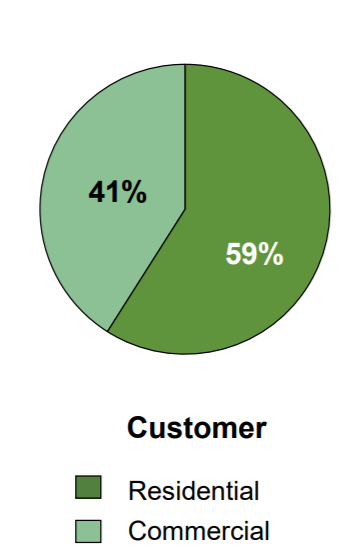
Lennox is still majority residential services which does expose it to consumer spending behavior and the housing market. Consumer demand for HVAC units and services as well as new technology including smart thermostats developed by Lennox will ultimately be a major driving force behind growth in the residential business segment. However, what's important is that while Lennox is almost 60% residential, nearly 3/4 of their business across both the commercial and residential segments are focused on maintenance and service, not initial construction. As a result, the residential business segment has seen relatively slow but consistent and stable growth in the past several years.

In the residential segment, revenues between 2013 and 2017 modestly grew from $3.2 billion to $3.8 billion with $3.9 billion expected for 2018. In the historical timespan, there isn't a single year when revenue fell. Along with this, GAAP EPS grew from $3.55 in 2013 to $7.17 in 2017 with full-year 2018 EPS estimates of $8.79-9.39. Free cash flow has increased from $134 million to $395 million. So revenue is growing slowly, but Lennox is driving the bottom line to some seriously impressive margin improvements. But what about that cyclicality? What if we go back further to analyze the historical price trends?
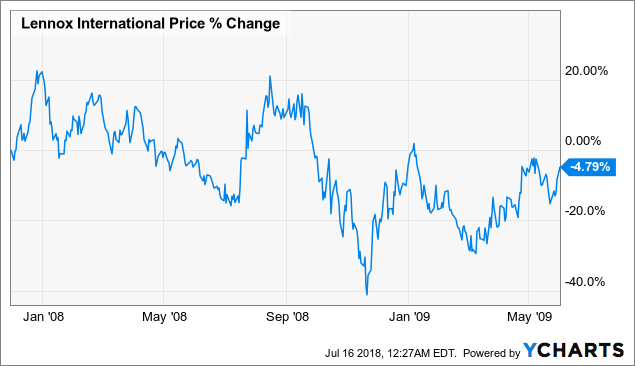
Chart LII data by YCharts

With Lennox historically being heavily concentrated in the residential segment, you would think that the housing market crash and decline in consumer confidence and spending would wreak havoc on Lennox. The stock declined a mere 5% over the course of the recession, and it's largely to do with Lennox's residential business segment being concentrated in the sale of residential HVAC units to contractors as well as an emphasis on recurring revenue from preventative maintenance and service. Because of the structure of Lennox's revenue model, they were largely insulated from the economic pressures around them.

Commercial Success With Variety of Contracts

Though the residential segment makes up a larger percentage of revenues for Lennox, the commercial segment has also performed well over the past several years. Its success can be attributed to the reason for the residential segment's consistent performance: diversification of revenue sources.

Lennox derives part of its commercial revenue from straight commercial sales to other commercial HVAC companies in the B2B market. However, a larger percentage of the sales in the commercial segment come from national accounts with large corporations, sale of individual parts to local contractors, and HVAC projects for different verticals. Lennox's national account services provide its HVAC equipment, installation & service, and customer support. Some of its customers include distribution centers, large hospitals, and national department stores.

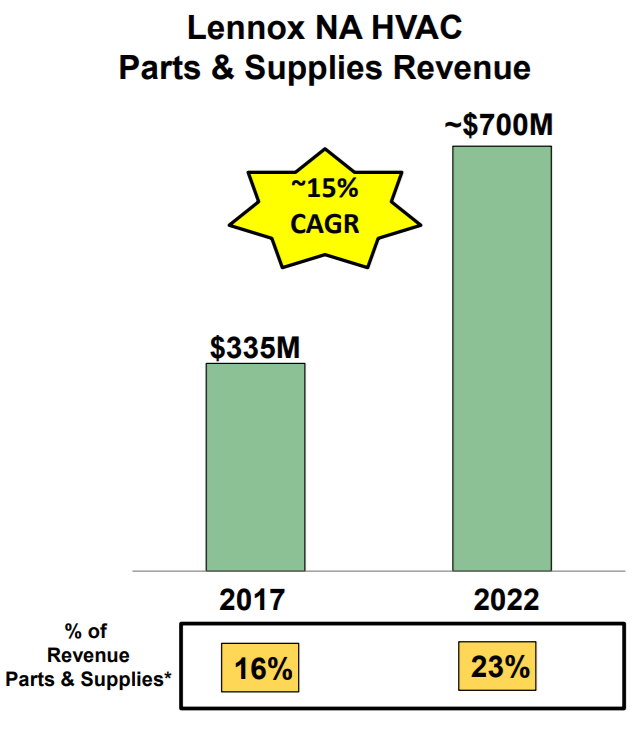
Along with this, Lennox also serves to the commercial market in its Lennox PartsPlus stores. Sales to local contractors across the country puts Lennox equipment into the hands of thousands of small businesses.
Lennox International - 2018 William Blair Growth Stock Conference

The stores, through both residential sales, and more importantly, commercial sales, have provided an outlet for Lennox to gain traction in the retail segment boosted by same stores sale growth and a strategy to get its products used by contractors nationwide.

The third revenue source for Lennox includes contracts with local businesses including manufacturing firms, schools, and small-rise office buildings. Total commercial heating and cooling revenue rose from $918 million to $974 million from 2016 to 2017 and service revenue from $133 million to an estimated $190 million by 2020. With an increasing number of contracts being won with both local and national companies, service revenue will likely meet or exceed these estimates.

A Differentiated Refrigeration Strategy

Similar to how HVAC can be performed by tens of thousands of small businesses across the country, so can refrigeration services. Lennox has leveraged its size and expertise as a multi-billion dollar firm in the HVAC and refrigeration space to create differentiating characteristics in its refrigeration business to give itself several advantages.

Lennox International operates in several refrigeration markets including food retail, non-food, cold storage, and food service. In a typical gas station convenience store that would qualify as "food retail", a Lennox refrigeration system can run $20K for parts & installation, let alone consistent maintenance and service. For a small-medium sized warehouse, a cold storage system that Lennox installs is typically around $350K along with annual maintenance fees. Where Lennox differentiates itself is it doesn't just install and service its refrigeration units, but it also provides leading technology monitoring systems, flexible order capabilities, and alternative refrigerants tailored to the needs of individual businesses. Sales in the refrigeration segment have been relatively stagnant but not declining at around $720 million in sales at a 13% margin for the past three years; however, the introduction of controllers and innovative monitoring systems was just recently introduced.

Consistency Leads to Free Cash Flow Growth and Dividend Increases

As mentioned in the discussion of Lennox International's core three business segments, revenue has not grown particularly fast, but the growth has been consistent even in times of economic downturns. The year over year upwards trend across Lennox's business segments has led to a substantial improvement in the company's cash flow. In 2014, the company generated approximately $185 million from operating activities. In 2017, that figure was $325 million and estimates from June 2018 place guidance for $495 million from operating activities for 2018. With an increase in business operations to be focused on service and maintenance as well as contracts with local businesses for new installation. The shift to an increased focus on this business model has not only increased revenues but also kept capital expenditures relatively constant. While cash flow from operating activities has ballooned to nearly $500 million for 2018 estimates, the company expects only around $100 million in capex and has spent between $80-100 million the past three years despite growth.

The free cash flow growth has also lent to dividend increases in recent years. Despite being a public company since 1999, it's just since 2012 since the company began increasing its dividend annually. The current yield sits at 1.20% which isn't particularly high, but the payout ratio is only around 25%, leaving the dividend payouts with a substantial amount of room to rise in the coming years should Lennox continue to issue dividend increases.

On a macro scale, Lennox should benefit from overall growth in the North American HVAC market as well as productivity increases from service contracts with national and local vendors and innovations in technology. Some risks to consider are commodity prices as the build costs of new HVAC systems is capital intensive and sensitive to the pricings of raw materials. Other risks to an investment in Lennox are strategic investments not seeing the forecasted benefits. As Lennox continues to scale up it looks to seek new partnerships such as its increased PartsPlus presence and development of new technologies. Heavy investment into these brand developments could cost the company significantly should these strategic moves not pay off.

Lennox International is a buy with no specific time frame. As the company has not had a significant downturn in quite some time, the company is a good addition to a portfolio for consistent gains and is up approximately 15% since last July.

Disclosure: I/we have no positions in any stocks mentioned, and no plans to initiate any positions within the next 72 hours.

I wrote this article myself, and it expresses my own opinions. I am not receiving compensation for it (other than from Seeking Alpha). I have no business relationship with any company whose stock is mentioned in this article.

Monday, July 16, 2018

Best Tech Stocks To Watch For 2019

tags:BLIN ,MGIC,AMAT,EVTC,IIJI,ITW,

Three deals are on the calendar for the week ahead looking to raise a combined $849 million. Highly-anticipated Dropbox (Pending:DBX) leads the week in the largest IPO from a US tech company since Snap (NYSE:SNAP) in the 1Q17. It comes on the heels of 2018's first unicorn Zscaler (Pending:ZS), which traded up 106% on its market debut.

U.S. IPO Calendar

Issuer
Business

Deal Size
Market Cap

Price Range
Shares Filed

Top
Bookrunners

Dropbox
San Francisco, CA

$612M
$7,640M

$16 - $18
36,000,000

Goldman
JP Morgan

Leading web-based cloud storage and collaboration platform.

PolyPid
Petach Tikva, Israel

$75M
$370M

Best Tech Stocks To Watch For 2019: Bridgeline Digital, Inc.(BLIN )

Advisors' Opinion:
  • [By Stephan Byrd]

    Get a free copy of the Zacks research report on Bridgeline Digital (BLIN)

    For more information about research offerings from Zacks Investment Research, visit Zacks.com

  • [By Ethan Ryder]

    Headlines about Bridgeline Digital (NASDAQ:BLIN) have trended somewhat positive on Sunday, Accern Sentiment reports. The research firm ranks the sentiment of news coverage by analyzing more than twenty million news and blog sources in real time. Accern ranks coverage of publicly-traded companies on a scale of negative one to positive one, with scores closest to one being the most favorable. Bridgeline Digital earned a daily sentiment score of 0.17 on Accern’s scale. Accern also gave media coverage about the software maker an impact score of 46.3358005969314 out of 100, indicating that recent news coverage is somewhat unlikely to have an impact on the stock’s share price in the immediate future.

Best Tech Stocks To Watch For 2019: Magic Software Enterprises Ltd.(MGIC)

Advisors' Opinion:
  • [By Logan Wallace]

    ValuEngine lowered shares of Magic Software Enterprises (NASDAQ:MGIC) from a buy rating to a hold rating in a report issued on Monday.

    Several other equities research analysts have also recently issued reports on MGIC. Zacks Investment Research raised shares of Magic Software Enterprises from a sell rating to a hold rating in a research report on Wednesday, January 17th. BidaskClub cut shares of Magic Software Enterprises from a sell rating to a strong sell rating in a research report on Tuesday, January 23rd. Finally, HC Wainwright set a $10.00 target price on shares of Magic Software Enterprises and gave the stock a buy rating in a research report on Thursday, March 1st. Two analysts have rated the stock with a sell rating, one has issued a hold rating and three have issued a buy rating to the company’s stock. The company has an average rating of Hold and an average target price of $9.81.

  • [By Shane Hupp]

    Get a free copy of the Zacks research report on Magic Software Enterprises (MGIC)

    For more information about research offerings from Zacks Investment Research, visit Zacks.com

  • [By Logan Wallace]

    HC Wainwright set a $10.00 target price on Magic Software Enterprises (NASDAQ:MGIC) in a research note released on Thursday morning. The firm currently has a buy rating on the software maker’s stock.

  • [By Logan Wallace]

    Get a free copy of the Zacks research report on Magic Software Enterprises (MGIC)

    For more information about research offerings from Zacks Investment Research, visit Zacks.com

  • [By Lisa Levin]

    Magic Software Enterprises Ltd. (NASDAQ: MGIC) is estimated to report quarterly earnings at $0.14 per share on revenue of $67.07 million.

    Canadian Solar Inc. (NASDAQ: CSIQ) is projected to report quarterly earnings at $0.47 per share on revenue of $1.34 billion.

Best Tech Stocks To Watch For 2019: Applied Materials, Inc.(AMAT)

Advisors' Opinion:
  • [By Chris Lange]

    Short interest in Applied Materials Inc. (NASDAQ: AMAT) fell to 15.04 million shares. The previous reading was 16.83 million. Shares were trading at $50.56, in a 52-week range of $40.79 to $62.40.

  • [By Stephan Byrd]

    Investors bought shares of Applied Materials, Inc. (NASDAQ:AMAT) on weakness during trading hours on Friday. $465.83 million flowed into the stock on the tick-up and $95.96 million flowed out of the stock on the tick-down, for a money net flow of $369.87 million into the stock. Of all stocks tracked, Applied Materials had the 7th highest net in-flow for the day. Applied Materials traded down ($0.38) for the day and closed at $49.31

  • [By Chris Lange]

    Short interest in Applied Materials Inc. (NASDAQ: AMAT) increased slightly to 11.88 million shares. The previous reading was 11.82 million. Shares were trading at $49.05, in a 52-week range of $34.58 to $60.89.

  • [By Lisa Levin]

    Some of the stocks that may grab investor focus today are:

    Wall Street expects Walmart Inc. (NYSE: WMT) to report quarterly earnings at $1.13 per share on revenue of $120.51 billion before the opening bell. Walmart shares gained 1 percent to $86.99 in after-hours trading. Analysts expect Applied Materials, Inc. (NASDAQ: AMAT) to post quarterly earnings at $1.14 per share on revenue of $4.45 billion after the closing bell. Applied Materials shares rose 0.15 percent to $55.25 in after-hours trading. Jack in the Box Inc. (NASDAQ: JACK) reported downbeat results for its second quarter. Comps were down 0.1 percent in the quarter. The company sees third-quarter comps coming in flat to up 1 percent. Jack in the Box shares dropped 3.03 percent to $88.60 in the after-hours trading session. Before the opening bell, Dillard's, Inc. (NYSE: DDS) is estimated to report quarterly earnings at $2.77 per share on revenue of $1.46 billion. Dillard's shares rose 0.14 percent to $72.10 in after-hours trading. Analysts are expecting Childrens Place Inc (NASDAQ: PLCE) to have earned $2.21 per share on revenue of $444.14 million in the latest quarter. Childrens Place will release earnings before the markets open. Childrens Place shares gained 0.29 percent to $138.40 in after-hours trading.

    Find out what's going on in today's market and bring any questions you have to Benzinga's PreMarket Prep.

  • [By Logan Wallace]

    Ostrum Asset Management lifted its holdings in shares of Applied Materials, Inc. (NASDAQ:AMAT) by 214.5% in the first quarter, according to the company in its most recent filing with the Securities and Exchange Commission (SEC). The fund owned 17,386 shares of the manufacturing equipment provider’s stock after buying an additional 11,857 shares during the period. Ostrum Asset Management’s holdings in Applied Materials were worth $967,000 at the end of the most recent quarter.

Best Tech Stocks To Watch For 2019: Evertec, Inc.(EVTC)

Advisors' Opinion:
  • [By Shane Hupp]

    Equities research analysts at Raymond James initiated coverage on shares of Evertec (NYSE:EVTC) in a report released on Friday, MarketBeat reports. The firm set a “market perform” rating on the business services provider’s stock.

  • [By Joseph Griffin]

    Evertec (NYSE:EVTC) was downgraded by equities research analysts at ValuEngine from a “buy” rating to a “hold” rating in a research note issued to investors on Saturday.

Best Tech Stocks To Watch For 2019: Internet Initiative Japan Inc.(IIJI)

Advisors' Opinion:
  • [By Logan Wallace]

    Get a free copy of the Zacks research report on Internet Initiative Japan (IIJI)

    For more information about research offerings from Zacks Investment Research, visit Zacks.com

Best Tech Stocks To Watch For 2019: Illinois Tool Works Inc.(ITW)

Advisors' Opinion:
  • [By ]

    Illinois Tools Works (ITW) shares fell after the company's earnings report, but Cramer and the AAP team see it as an opportunity to buy more shares. Find out what they're telling their investment club members and get in on the conversation with a free trial subscription to Action Alerts PLUS.

  • [By Joseph Griffin]

    Millennium Management LLC increased its stake in shares of Illinois Tool Works Inc. (NYSE:ITW) by 786.2% during the first quarter, according to its most recent disclosure with the Securities and Exchange Commission. The firm owned 427,605 shares of the industrial products company’s stock after acquiring an additional 379,356 shares during the quarter. Millennium Management LLC’s holdings in Illinois Tool Works were worth $66,989,000 at the end of the most recent reporting period.

  • [By ]

    Cramer and the AAP team are trimming Illinois Tool Works (ITW) and Danaher (DHR) . Find out what they're telling their investment club members and get in on the conversation with a free trial subscription to Action Alerts PLUS.

Friday, July 13, 2018

Reviewing Kearny Financial (KRNY) and Northrim BanCorp (NRIM)

Kearny Financial (NASDAQ: KRNY) and Northrim BanCorp (NASDAQ:NRIM) are both small-cap finance companies, but which is the better investment? We will compare the two companies based on the strength of their earnings, valuation, institutional ownership, risk, profitability, analyst recommendations and dividends.

Profitability

Get Kearny Financial alerts:

This table compares Kearny Financial and Northrim BanCorp’s net margins, return on equity and return on assets.

Net Margins Return on Equity Return on Assets
Kearny Financial 9.92% 2.01% 0.42%
Northrim BanCorp 13.47% 8.45% 1.08%

Analyst Recommendations

This is a summary of current ratings and price targets for Kearny Financial and Northrim BanCorp, as provided by MarketBeat.

Sell Ratings Hold Ratings Buy Ratings Strong Buy Ratings Rating Score
Kearny Financial 1 0 0 0 1.00
Northrim BanCorp 0 0 0 0 N/A

Kearny Financial presently has a consensus price target of $13.50, indicating a potential downside of 2.53%. Given Kearny Financial’s higher possible upside, research analysts clearly believe Kearny Financial is more favorable than Northrim BanCorp.

Valuation and Earnings

This table compares Kearny Financial and Northrim BanCorp’s revenue, earnings per share (EPS) and valuation.

Gross Revenue Price/Sales Ratio Net Income Earnings Per Share Price/Earnings Ratio
Kearny Financial $150.44 million 9.43 $18.60 million N/A N/A
Northrim BanCorp $100.58 million 2.75 $13.15 million $2.04 19.73

Kearny Financial has higher revenue and earnings than Northrim BanCorp.

Volatility and Risk

Kearny Financial has a beta of 0.57, meaning that its stock price is 43% less volatile than the S&P 500. Comparatively, Northrim BanCorp has a beta of 0.78, meaning that its stock price is 22% less volatile than the S&P 500.

Dividends

Kearny Financial pays an annual dividend of $0.16 per share and has a dividend yield of 1.2%. Northrim BanCorp pays an annual dividend of $0.96 per share and has a dividend yield of 2.4%. Northrim BanCorp pays out 47.1% of its earnings in the form of a dividend.

Institutional & Insider Ownership

51.2% of Kearny Financial shares are held by institutional investors. Comparatively, 70.5% of Northrim BanCorp shares are held by institutional investors. 3.8% of Kearny Financial shares are held by insiders. Comparatively, 2.9% of Northrim BanCorp shares are held by insiders. Strong institutional ownership is an indication that endowments, hedge funds and large money managers believe a company will outperform the market over the long term.

Summary

Kearny Financial beats Northrim BanCorp on 7 of the 13 factors compared between the two stocks.

Kearny Financial Company Profile

Kearny Financial Corp. operates as the holding company for Kearny Bank that provides various banking products and services in the United States. It offers various deposit products, including interest-bearing and non-interest-bearing checking accounts, money market deposit accounts, savings accounts, and certificates of deposit accounts. The company also provides various loans comprising one-to-four family mortgage loans; commercial mortgages, including loans secured by multi-family, mixed-use, and nonresidential properties; secured and unsecured business loans; consumer loans, such as home equity loans, home equity lines of credit, account loans, overdraft lines of credit, vehicle loans, personal loans, and loans secured by savings accounts and certificates of deposit; and construction loans to builders/developers and individual homeowners. In addition, it sells insurance products to its customers and the general public through a third party networking arrangement. As of August 16, 2017, the company operated 42 branches located in northern and central New Jersey, and Brooklyn and Staten Island, New York. Kearny Financial Corp. was founded in 1884 and is headquartered in Fairfield, New Jersey.

Northrim BanCorp Company Profile

Northrim BanCorp, Inc. operates as the bank holding company for Northrim Bank that provides commercial banking products and services to businesses and professionals in Alaska. The company operates in two segments, Community Banking and Home Mortgage Lending. It offers various deposit products, including noninterest-bearing checking accounts and interest-bearing time deposits, checking accounts, and savings accounts, as well as money market deposit accounts, certificates of deposit, and courier noncash deposits. The company also provides family residential mortgages; commercial loans, such as secured and unsecured loans for working capital and expansion; commercial real estate loans; construction loans for commercial real estate projects, and land development and residential subdivision construction loans; and consumer loans comprising loans for automobiles, recreational vehicles, boats, and other consumer purchases, as well as home equity and commercial credit lines, and factoring services. In addition, it offers other services comprising consumer online banking, mobile app and mobile deposit, mobile Web and text banking, business online banking, personal finance, online documents, consumer and business debit cards, personalized checks at account opening, telebanking, automated teller, overdraft protection from a savings account, commercial drive-up banking, automatic transfers and payments, wire transfers, direct payroll deposit, electronic tax payments, automated clearing house origination and receipt, remote deposit capture, merchant, and cash management services, as well as annuity products, and long term investment portfolios. As of January 29, 2018, the company operated 14 branches in Anchorage, the Matanuska Valley, Juneau, Fairbanks, Ketchikan, and Sitka. Northrim BanCorp, Inc. was founded in 1990 and is headquartered in Anchorage, Alaska.

Wednesday, July 11, 2018

How Thailand became the 'Detroit of Asia'

If you bought a vehicle in Southeast Asia or Australia -- especially a pickup -- there's a good chance it was built in Thailand.

Thailand has been a stronghold for automobile manufacturing for decades. It nicknamed itself "the Detroit of Asia," and the moniker stuck, with good reason. It's currently the 12th most industrious auto manufacturer in the world, and the largest in Southeast Asia.

Japanese makers like Toyota and Mitsubishi have had operations in Thailand since the 1960s. GM, Ford, Mercedes and BMW all followed. A GM spokesperson said that its plant is a major manufacturing hub for the Asia-Pacific region and Africa, and its vehicles are exported to 15 markets, including Australia and New Zealand.

How did Thailand become an automaking giant?

For three decades, Thailand has imposed an 80% import tariff on cars and 60% on motorcycles, to keep manufacturing within the country. The government offers land ownership rights for foreign investors and smooth visa and permit processes for foreign auto advisers.

Meanwhile, Thailand's government introduced various tax incentives favorable to foreign investors. Companies relocating to Thailand are exempt from corporate income tax for eight years. In some areas of the country, such as automaking hub Rayong, where GM and Ford are based, Thailand reduced corporate tax rates by up to 50%.

Thailand is also well located geographically with convenient ports and airports, allowing exporting ease. Unlike in Indonesia and other competing markets, most auto parts are made and sourced internally -- with around 1,500 suppliers in Thailand today -- so there's little need to import them. And a free trade agreement with the nine other countries of the Association of Southeast Asian Nations is another bonus: Automakers in Thailand pay zero or highly reduced tariffs for exporting autos within the region.

Labor is cheaper than in developed nations and China, though not as cheap as in surrounding Southeast Asian nations. But the fact that the labor force has amassed skill and experience is critical.

"This has helped to retain investment in the face of competition from markets such as Vietnam or Indonesia that offer lowered labor costs," said Maxfield Brown, manager of the Business Intelligence Unit at Dezan Shira & Associates.

Exploding growth

In 2002, the Thai Automotive Institute announced a six-year plan to transform Thailand into "the Detroit of Asia." Between 2000 and 2017, Thailand's auto production grew by 383%.

Although exports account for almost 60% of Thai production, the domestic market is showing signs of growth, in part because of the Thai rising middle class. Only 18% of households did not own a vehicle in 2013, according to numbers from the Nielsen Global Survey of Automotive Demand.

Southeast Asia's middle class will more than double to 400 million by 2020, as predicted by the Organization for Economic Cooperation and Development. That spells huge opportunity for automakers in Thailand.

Thailand excels at making commercial vehicles -- specifically, the one-ton pickup truck, such as the Chevrolet Colorado and the Ford Ranger. Thailand is the world's second-biggest market for pickups, after the United States. Much of the country is rural, and pickups serve as economical vehicles for large families, with children often sitting in the open-air back.

GM only makes two vehicles in Thailand: the Colorado and the Chevy Trailblazer SUV. It said that pickups represent 42% of the market share in Thailand.

"Since 2000, GM has invested more than $2 billion in the manufacturing facilities in Rayong," a GM spokesman said. "We continue to invest in Thailand through our dealers, products and services."

Thailand produced 1.2 million commercial vehicles compared to 818,000 cars in 2017. Conversely, growing producer Indonesia made just 234,000 commercial vehicles but 982,000 cars. Still, in the first five months of 2018, overall car sales in Thailand grew by 18%. A spokesperson for Mercedes-Benz, which makes only passenger cars in Thailand, said the company had its biggest year ever in 2017, with 14,000 units sold.

What's on the horizon?

To help ensure that wheels keep turning in the future, the government wants to attract eco-friendly and electric car production to Thailand, as part of its ambitious new $45 billion project approved in February, known as the Eastern Economic Corridor.

It comprises numerous trade and development initiatives to further boost its industrial epicenter in Rayong and surrounding provinces. Thailand will continue to provide tax breaks and fast-track visas to investors, as well as the ability to rent land for up to 99 years.

The Federal Thailand Investment Board predicts the country will produce 3 million autos in 2020, which would propel it into 8th place in global production.

But political uncertainty has unsettled investors, notes Josh Kurlantzick, senior fellow for Southeast Asia at the Council on Foreign Relations. Coups in 2006 and 2014 rattled automakers.

"Years of political strife has undercut its appeal," Kurlantzick said.

Competition from neighboring nations is also growing, though Thailand's outlook remains bright.

"Indonesia's domestic automotive market has seen steady growth in recent years but still lags behind Thailand in both volume and supply chain sophistication," Brown said.

Tuesday, July 10, 2018

The Best Nasdaq Stocks to Buy Right Now

Chris JohnsonChris Johnson

Last week, I showed you the results of a quick study I did on the performance of Nasdaq 100 stocks when the CBOE Volatility Index (VIX) falls below 15.

The results were surprising – even to me.

While I expected some strength in the group, I was blown away by the average 37% return in the 14 months between December 2016 and February 2018.

I promised you some tickers – top performers from that studied group that have done very well of late and should continue to outperform.

Buckle up: Here they are…

Join the conversation. Click here to jump to comments…

Chris JohnsonChris Johnson

About the Author

Browse Chris's articles | View Chris's research services

Chris Johnson is a quant - he's obsessed with building and perfecting mathematical models that allow him to predict, with startling accuracy, the direction of the markets, entire sectors, and individual securities. For the last year, he's been researching and building a new system that lets him move swiftly in and out of the hottest stocks in the market for life-changing gains - entirely on his own terms. The results of his newly-minted Night Trader system are nothing short of amazing.

Chris also contributes to Money Morning as the Quant Analysis Specialist.

… Read full bio

Monday, July 9, 2018

Emcor Group Inc (EME) Plans Quarterly Dividend of $0.08

Emcor Group Inc (NYSE:EME) declared a quarterly dividend on Monday, July 9th, RTT News reports. Stockholders of record on Friday, July 20th will be given a dividend of 0.08 per share by the construction company on Tuesday, July 31st. This represents a $0.32 dividend on an annualized basis and a dividend yield of 0.41%.

Emcor Group has a dividend payout ratio of 8.4% indicating that its dividend is sufficiently covered by earnings. Equities research analysts expect Emcor Group to earn $4.91 per share next year, which means the company should continue to be able to cover its $0.32 annual dividend with an expected future payout ratio of 6.5%.

Get Emcor Group alerts:

Shares of Emcor Group traded up $1.00, reaching $78.69, on Monday, Marketbeat Ratings reports. 853 shares of the company were exchanged, compared to its average volume of 217,180. The stock has a market capitalization of $4.54 billion, a PE ratio of 19.14, a price-to-earnings-growth ratio of 1.15 and a beta of 0.96. The company has a debt-to-equity ratio of 0.17, a current ratio of 1.43 and a quick ratio of 1.41. Emcor Group has a one year low of $62.15 and a one year high of $85.08.

Emcor Group (NYSE:EME) last released its quarterly earnings data on Thursday, April 26th. The construction company reported $0.94 earnings per share (EPS) for the quarter, topping the Zacks’ consensus estimate of $0.85 by $0.09. The company had revenue of $1.90 billion for the quarter, compared to analysts’ expectations of $1.80 billion. Emcor Group had a net margin of 2.99% and a return on equity of 14.89%. The business’s revenue was up .5% on a year-over-year basis. During the same quarter in the prior year, the firm earned $0.88 EPS. analysts anticipate that Emcor Group will post 4.49 earnings per share for the current fiscal year.

Separately, Zacks Investment Research cut shares of Emcor Group from a “strong-buy” rating to a “hold” rating in a research report on Tuesday, May 1st. One analyst has rated the stock with a sell rating, four have given a hold rating and one has given a buy rating to the company. The company presently has an average rating of “Hold” and an average price target of $86.00.

Emcor Group Company Profile

EMCOR Group, Inc provides electrical and mechanical construction, and facilities services in the United States. The company designs, integrates, installs, starts-up, operates, and maintains electric power transmission and distribution systems; premises electrical and lighting systems; process instrumentation in the refining, chemical process, food process, and mining industries; low-voltage, voice and data communications, fire protection, water and wastewater treatment, and controls and filtration systems; roadway and transit lighting and fiber-optic lines; heating, ventilation, air conditioning, refrigeration, and clean-room process ventilation systems; plumbing, processing, and piping systems; and central plant heating and cooling systems, as well as offers cranes and rigging, millwrighting, and steel fabrication, erection, and welding services.

Dividend History for Emcor Group (NYSE:EME)

Thursday, July 5, 2018

Amicus Therapeutics, Inc. (FOLD) CFO William D. Baird III Sells 10,000 Shares

Amicus Therapeutics, Inc. (NASDAQ:FOLD) CFO William D. Baird III sold 10,000 shares of the company’s stock in a transaction that occurred on Monday, July 2nd. The shares were sold at an average price of $15.63, for a total value of $156,300.00. Following the completion of the transaction, the chief financial officer now directly owns 117,622 shares in the company, valued at $1,838,431.86. The transaction was disclosed in a filing with the SEC, which is available at this link.

Amicus Therapeutics traded down $0.05, hitting $15.90, during midday trading on Thursday, MarketBeat reports. The company’s stock had a trading volume of 1,521,800 shares, compared to its average volume of 2,783,068. The stock has a market capitalization of $3.01 billion, a PE ratio of -5.43 and a beta of 1.38. Amicus Therapeutics, Inc. has a 12 month low of $10.09 and a 12 month high of $17.62. The company has a current ratio of 4.21, a quick ratio of 4.15 and a debt-to-equity ratio of 0.32.

Get Amicus Therapeutics alerts:

Amicus Therapeutics (NASDAQ:FOLD) last announced its earnings results on Tuesday, May 8th. The biopharmaceutical company reported ($0.28) earnings per share for the quarter, beating analysts’ consensus estimates of ($0.36) by $0.08. The business had revenue of $16.70 million during the quarter, compared to analyst estimates of $16.78 million. Amicus Therapeutics had a negative net margin of 563.98% and a negative return on equity of 60.09%. research analysts predict that Amicus Therapeutics, Inc. will post -1.3 earnings per share for the current year.

Several equities analysts recently issued reports on the company. BidaskClub raised Amicus Therapeutics from a “hold” rating to a “buy” rating in a research report on Friday, April 13th. ValuEngine raised Amicus Therapeutics from a “hold” rating to a “buy” rating in a research report on Monday, April 2nd. Zacks Investment Research raised Amicus Therapeutics from a “sell” rating to a “hold” rating in a research report on Tuesday, March 20th. Finally, Cowen reaffirmed a “buy” rating and issued a $22.00 price objective on shares of Amicus Therapeutics in a research report on Tuesday, May 8th. Three equities research analysts have rated the stock with a hold rating, six have given a buy rating and one has issued a strong buy rating to the company. The company currently has a consensus rating of “Buy” and an average price target of $19.06.

A number of institutional investors and hedge funds have recently made changes to their positions in the business. BNP Paribas Arbitrage SA raised its stake in Amicus Therapeutics by 14.1% during the 1st quarter. BNP Paribas Arbitrage SA now owns 39,810 shares of the biopharmaceutical company’s stock valued at $599,000 after buying an additional 4,923 shares during the last quarter. Teachers Advisors LLC raised its stake in Amicus Therapeutics by 0.9% during the 4th quarter. Teachers Advisors LLC now owns 663,936 shares of the biopharmaceutical company’s stock valued at $9,554,000 after buying an additional 5,858 shares during the last quarter. American International Group Inc. raised its stake in Amicus Therapeutics by 5.9% during the 1st quarter. American International Group Inc. now owns 119,167 shares of the biopharmaceutical company’s stock valued at $1,792,000 after buying an additional 6,684 shares during the last quarter. QS Investors LLC raised its stake in Amicus Therapeutics by 4.9% during the 4th quarter. QS Investors LLC now owns 159,008 shares of the biopharmaceutical company’s stock valued at $2,288,000 after buying an additional 7,483 shares during the last quarter. Finally, MetLife Investment Advisors LLC raised its stake in Amicus Therapeutics by 11.3% during the 1st quarter. MetLife Investment Advisors LLC now owns 85,724 shares of the biopharmaceutical company’s stock valued at $1,289,000 after buying an additional 8,736 shares during the last quarter.

About Amicus Therapeutics

Amicus Therapeutics, Inc, a biotechnology company, engages in the discovery, development, and commercialization of medicines for various rare and orphan diseases. The company offers migalastat HCl, an orally administered small molecule pharmacological chaperone for the treatment of Fabry disease. It is also conducting a Phase 1/2 clinical study of ATB200-02 to investigate in patients with pompe disease.

Insider Buying and Selling by Quarter for Amicus Therapeutics (NASDAQ:FOLD)

Wednesday, July 4, 2018

Dog from Bush's Baked Beans commercials dies

As millions of Americans gather for grill-outs this Independence Day, they might well ladle an extra helping of Bush's baked beans for Duke��� or the furry actor who played him, to be precise.

A dog who once portrayed "Duke," the talking canine entrusted� in ads with the Bush's family recipe,�died last week amid a bout with cancer. That's according to David Odom of�Apopka, Florida, who detailed his friendship with the dog's owner in a post online.�

"His name is actually Sam. He lived in Apopka with our friend Susan, his owner. She trains animals to work in commercials," Odom said Thursday on Facebook. "Not just hers but others as well. Sadly she had to euthanize Sam yesterday due to an aggressive cancer he was suffering from.�She is, as we are, heartbroken."

.oembed-frame { width: 100%; height: 100%; margin: 0; border: 0; }

Sam was one of several dogs over the years to portray Duke, the�dog given the family's secret�recipe in commercials by Bush's spokesman Jay Bush with and determined to sell it. The two have been "the embodiment of the BUSH��S brand" for more than 20 years,�the company said in a statement Tuesday.�

"During that time, we've worked closely with several dogs who portrayed Duke in our commercials, including Sam," the company said in a post on Facebook. "While Sam has not worked with us in years, we are saddened by the news of his passing and are grateful to have had him depict Duke."

Post by bushbeans.

More: Women's razor ad may be the first to feature hairy legs (and armpits, and bikini lines)

Monday, June 25, 2018

Spdr Bloomberg Barclays International Treasury Bond Etf (BWX) Shares Bought by Natixis

Natixis boosted its stake in shares of Spdr Bloomberg Barclays International Treasury Bond Etf (BMV:BWX) by 5.9% during the 1st quarter, according to its most recent 13F filing with the SEC. The firm owned 34,615 shares of the company’s stock after buying an additional 1,936 shares during the period. Natixis owned approximately 0.07% of Spdr Bloomberg Barclays International Treasury Bond Etf worth $1,020,000 as of its most recent filing with the SEC.

Other hedge funds also recently made changes to their positions in the company. Blackhawk Capital Partners LLC. grew its stake in shares of Spdr Bloomberg Barclays International Treasury Bond Etf by 32.3% during the 1st quarter. Blackhawk Capital Partners LLC. now owns 186,905 shares of the company’s stock worth $5,516,000 after acquiring an additional 45,679 shares in the last quarter. Perigon Wealth Management LLC grew its stake in shares of Spdr Bloomberg Barclays International Treasury Bond Etf by 21.2% during the 1st quarter. Perigon Wealth Management LLC now owns 34,483 shares of the company’s stock worth $1,018,000 after acquiring an additional 6,026 shares in the last quarter. IHT Wealth Management LLC grew its stake in shares of Spdr Bloomberg Barclays International Treasury Bond Etf by 65.9% during the 1st quarter. IHT Wealth Management LLC now owns 28,586 shares of the company’s stock worth $845,000 after acquiring an additional 11,357 shares in the last quarter. Change Path LLC bought a new position in shares of Spdr Bloomberg Barclays International Treasury Bond Etf during the 1st quarter worth approximately $4,949,000. Finally, Commonwealth Equity Services LLC grew its stake in shares of Spdr Bloomberg Barclays International Treasury Bond Etf by 4.0% during the 1st quarter. Commonwealth Equity Services LLC now owns 170,550 shares of the company’s stock worth $5,032,000 after acquiring an additional 6,551 shares in the last quarter.

Get Spdr Bloomberg Barclays International Treasury Bond Etf alerts:

Shares of Spdr Bloomberg Barclays International Treasury Bond Etf opened at $27.85 on Friday, according to Marketbeat Ratings. Spdr Bloomberg Barclays International Treasury Bond Etf has a twelve month low of $544.00 and a twelve month high of $559.50.

The company also recently announced a monthly dividend, which was paid on Thursday, June 7th. Investors of record on Monday, June 4th were paid a $0.0234 dividend. The ex-dividend date was Friday, June 1st. This is a boost from Spdr Bloomberg Barclays International Treasury Bond Etf’s previous monthly dividend of $0.02. This represents a $0.28 annualized dividend and a dividend yield of 1.01%.

Institutional Ownership by Quarter for Spdr Bloomberg Barclays International Treasury Bond Etf (BMV:BWX)

Sunday, June 24, 2018

$11.00 Million in Sales Expected for Hannon Armstrong Sustnbl Infrstr Cap Inc (HASI) This Quarter

Wall Street analysts expect Hannon Armstrong Sustnbl Infrstr Cap Inc (NYSE:HASI) to announce $11.00 million in sales for the current fiscal quarter, according to Zacks. Four analysts have made estimates for Hannon Armstrong Sustnbl Infrstr Cap’s earnings, with the lowest sales estimate coming in at $10.03 million and the highest estimate coming in at $11.90 million. Hannon Armstrong Sustnbl Infrstr Cap posted sales of $12.91 million in the same quarter last year, which suggests a negative year-over-year growth rate of 14.8%. The firm is expected to issue its next earnings results on Wednesday, August 1st.

On average, analysts expect that Hannon Armstrong Sustnbl Infrstr Cap will report full-year sales of $46.05 million for the current financial year, with estimates ranging from $42.92 million to $51.00 million. For the next year, analysts forecast that the business will report sales of $50.01 million per share, with estimates ranging from $41.60 million to $57.00 million. Zacks Investment Research’s sales calculations are an average based on a survey of sell-side analysts that that provide coverage for Hannon Armstrong Sustnbl Infrstr Cap.

Get Hannon Armstrong Sustnbl Infrstr Cap alerts:

Hannon Armstrong Sustnbl Infrstr Cap (NYSE:HASI) last posted its earnings results on Thursday, May 3rd. The real estate investment trust reported $0.27 earnings per share (EPS) for the quarter, missing the Zacks’ consensus estimate of $0.31 by ($0.04). The business had revenue of $9.20 million for the quarter, compared to analyst estimates of $10.24 million. Hannon Armstrong Sustnbl Infrstr Cap had a return on equity of 8.40% and a net margin of 20.45%.

HASI has been the subject of a number of research analyst reports. Cowen set a $28.00 target price on shares of Hannon Armstrong Sustnbl Infrstr Cap and gave the stock a “buy” rating in a research report on Thursday, February 22nd. B. Riley set a $26.00 target price on shares of Hannon Armstrong Sustnbl Infrstr Cap and gave the stock a “buy” rating in a research report on Thursday, February 22nd. UBS Group initiated coverage on shares of Hannon Armstrong Sustnbl Infrstr Cap in a research report on Thursday, March 15th. They set a “buy” rating and a $21.00 target price for the company. Zacks Investment Research raised shares of Hannon Armstrong Sustnbl Infrstr Cap from a “sell” rating to a “hold” rating in a research report on Thursday, May 10th. Finally, Robert W. Baird reissued an “outperform” rating and set a $26.00 target price (down previously from $30.00) on shares of Hannon Armstrong Sustnbl Infrstr Cap in a research report on Thursday, February 22nd. One analyst has rated the stock with a sell rating, three have issued a hold rating and eight have given a buy rating to the stock. The stock presently has a consensus rating of “Buy” and an average price target of $25.89.

In other news, Director Steven G. Osgood acquired 5,000 shares of the stock in a transaction on Monday, June 4th. The stock was bought at an average price of $18.28 per share, with a total value of $91,400.00. Following the completion of the transaction, the director now directly owns 28,281 shares of the company’s stock, valued at $516,976.68. The transaction was disclosed in a document filed with the Securities & Exchange Commission, which is accessible through this hyperlink. Also, insider Jeffrey Eckel acquired 1,630 shares of the stock in a transaction on Wednesday, May 9th. The stock was purchased at an average cost of $18.95 per share, with a total value of $30,888.50. Following the transaction, the insider now directly owns 877,270 shares of the company’s stock, valued at $16,624,266.50. The disclosure for this purchase can be found here. Insiders acquired 22,435 shares of company stock valued at $411,277 in the last ninety days. 5.30% of the stock is owned by corporate insiders.

Several hedge funds have recently added to or reduced their stakes in HASI. Handelsbanken Fonder AB grew its position in shares of Hannon Armstrong Sustnbl Infrstr Cap by 130.1% during the first quarter. Handelsbanken Fonder AB now owns 944,483 shares of the real estate investment trust’s stock worth $18,417,000 after buying an additional 534,083 shares in the last quarter. Teachers Advisors LLC grew its position in shares of Hannon Armstrong Sustnbl Infrstr Cap by 386.2% during the fourth quarter. Teachers Advisors LLC now owns 426,796 shares of the real estate investment trust’s stock worth $10,269,000 after buying an additional 339,010 shares in the last quarter. American Assets Capital Advisers LLC bought a new position in Hannon Armstrong Sustnbl Infrstr Cap during the first quarter worth $6,068,000. Amundi Pioneer Asset Management Inc. bought a new position in Hannon Armstrong Sustnbl Infrstr Cap during the fourth quarter worth $7,401,000. Finally, Van ECK Associates Corp lifted its stake in Hannon Armstrong Sustnbl Infrstr Cap by 15.5% during the first quarter. Van ECK Associates Corp now owns 1,379,890 shares of the real estate investment trust’s stock worth $26,908,000 after purchasing an additional 184,817 shares during the last quarter. 71.80% of the stock is owned by institutional investors and hedge funds.

HASI traded down $0.02 on Tuesday, reaching $19.02. 5,147 shares of the company’s stock were exchanged, compared to its average volume of 380,416. The company has a market cap of $993.15 million, a PE ratio of 18.03, a price-to-earnings-growth ratio of 2.59 and a beta of 0.83. Hannon Armstrong Sustnbl Infrstr Cap has a twelve month low of $17.33 and a twelve month high of $25.28. The company has a debt-to-equity ratio of 2.28, a quick ratio of 38.94 and a current ratio of 38.94.

The company also recently disclosed a quarterly dividend, which will be paid on Thursday, July 12th. Shareholders of record on Thursday, July 5th will be given a $0.33 dividend. This represents a $1.32 annualized dividend and a yield of 6.94%. The ex-dividend date of this dividend is Tuesday, July 3rd. Hannon Armstrong Sustnbl Infrstr Cap’s dividend payout ratio (DPR) is 125.71%.

About Hannon Armstrong Sustnbl Infrstr Cap

Hannon Armstrong Sustainable Infrastructure Capital, Inc provides capital and services to the energy efficiency, renewable energy, and other sustainable infrastructure markets in the United States. The company's projects include energy efficiency projects that reduce a building's or facility's energy usage or cost through enhancing or installing various building components, including heating, ventilation, and air conditioning systems, as well as lighting, energy controls, roofs, windows, building shells, and/or combined heat and power systems.

Get a free copy of the Zacks research report on Hannon Armstrong Sustnbl Infrstr Cap (HASI)

For more information about research offerings from Zacks Investment Research, visit Zacks.com

Tuesday, June 19, 2018

Head-To-Head Comparison: Accenture (ACN) & Radware (RDWR)

Accenture (NYSE: ACN) and Radware (NASDAQ:RDWR) are both business services companies, but which is the better stock? We will contrast the two companies based on the strength of their institutional ownership, earnings, dividends, profitability, analyst recommendations, valuation and risk.

Dividends

Get Accenture alerts:

Accenture pays an annual dividend of $2.66 per share and has a dividend yield of 1.7%. Radware does not pay a dividend. Accenture pays out 45.0% of its earnings in the form of a dividend. Accenture has increased its dividend for 8 consecutive years.

Analyst Ratings

This is a summary of current recommendations for Accenture and Radware, as provided by MarketBeat.com.

Sell Ratings Hold Ratings Buy Ratings Strong Buy Ratings Rating Score
Accenture 1 9 13 0 2.52
Radware 0 0 5 0 3.00

Accenture presently has a consensus target price of $160.70, suggesting a potential downside of 0.16%. Radware has a consensus target price of $23.60, suggesting a potential downside of 4.72%. Given Accenture’s higher possible upside, research analysts plainly believe Accenture is more favorable than Radware.

Valuation & Earnings

This table compares Accenture and Radware’s top-line revenue, earnings per share (EPS) and valuation.

Gross Revenue Price/Sales Ratio Net Income Earnings Per Share Price/Earnings Ratio
Accenture $36.77 billion 2.78 $3.45 billion $5.91 27.24
Radware $211.37 million 5.22 -$7.49 million ($0.12) -206.42

Accenture has higher revenue and earnings than Radware. Radware is trading at a lower price-to-earnings ratio than Accenture, indicating that it is currently the more affordable of the two stocks.

Institutional and Insider Ownership

73.7% of Accenture shares are held by institutional investors. Comparatively, 62.5% of Radware shares are held by institutional investors. 0.2% of Accenture shares are held by company insiders. Comparatively, 21.6% of Radware shares are held by company insiders. Strong institutional ownership is an indication that large money managers, hedge funds and endowments believe a company will outperform the market over the long term.

Profitability

This table compares Accenture and Radware’s net margins, return on equity and return on assets.

Net Margins Return on Equity Return on Assets
Accenture 9.18% 41.50% 17.96%
Radware -2.03% -1.21% -0.82%

Volatility and Risk

Accenture has a beta of 1.03, suggesting that its stock price is 3% more volatile than the S&P 500. Comparatively, Radware has a beta of 0.92, suggesting that its stock price is 8% less volatile than the S&P 500.

Summary

Accenture beats Radware on 13 of the 17 factors compared between the two stocks.

Accenture Company Profile

Accenture plc provides consulting, technology, and outsourcing services worldwide. Its Communications, Media & Technology segment provides professional services that help clients accelerate and deliver digital transformation, and enhance business results through industry-specific solutions for communications, media, and high tech industries, as well as for software platforms. The company's Financial Services segment offers services that address profitability pressures, industry consolidation, regulatory changes, and the need to continually adapt to new digital technologies. This segment serves clients in banking, capital markets, and insurance industries. Its Health & Public Service segment provides research-based insights and offerings, including consulting services and digital solutions to help clients deliver social, economic, and health outcomes. This segment serves healthcare payers and providers, as well as government departments and agencies, public service organizations, educational institutions, and non-profit organizations. The company's Products segment helps clients enhance their performance in distribution, sales, and marketing; in research and development, and manufacturing; and in business functions, such as finance, human resources, procurement, and supply chain. This segment serves clients in consumer goods, retail, and travel services industries; automotive, freight and logistics, industrial and electrical equipment, consumer durable and heavy equipment, and construction and infrastructure management companies; and pharmaceutical, medical technology, and biotechnology companies. Its Resources segment enables clients to develop and implement strategies, improve operations, manage complex change initiatives, and integrate digital technologies. This segment serves clients in chemicals, energy, forest products, metals and mining, and utilities and related industries. Accenture plc was founded in 1989 and is based in Dublin, Ireland.
Radware Company Profile

Radware Ltd. develops, manufactures, and markets cyber security and application delivery solutions for applications in virtual, cloud, and software defined data centers worldwide. The company offers application and network security solutions, such as DefensePro, a real-time network attack prevention device; AppWall, a Web application firewall; and DefenseFlow, a cyber-command and control application. It also provides cloud-based emergency response team, attack mitigation, and firewall services; and subscription-based security update related to latest threats, and fraud and phishing attacks. In addition, the company offers application delivery solutions comprising Alteon D Line, an application delivery controller/load balancer for Web, cloud, and mobile based applications; LinkProof NG, a multi-homing and enterprise gateway solution for connectivity of enterprise and cloud-based applications; and FastView, a Web performance optimization and acceleration for end-user devices and browsers. Additionally, it offers APSolute Vision, a management and monitoring tool for company's application delivery and cyber security solutions; application performance monitoring to detect application performance issues; and vDirect, service orchestration and automation engine designed for software-defined data centers and clouds. The company also offers cloud DDoS protection, cloud malware protection, content delivery network, and cloud Web acceleration services, as well as support and maintenance services. The company sells its products primarily to independent distributors, including value added resellers, original equipment manufacturers, and system integrators. Radware Ltd. was founded in 1996 and is headquartered in Tel Aviv, Israel.


Wednesday, May 30, 2018

Movers & shakers: Volumes of these 5 stocks rose up to 45,000%

Market is trading on a�negative note�with the Nifty down 56 points at 10,631 and the Sensex was down 206 points at 34,958.

On the NSE,�Just Dial�gained�18.53 percent over the last�two days, while�Kiri Industries rose 17.38 percent and Uflex gained 16 percent.

Other big gainers over the period include KRBL, up 13.39� percent. Sakthi Sugars rose 13.15 percent while Patel Engineering�gained 11.3 percent.

Mentioned below are stocks that witnessed a surge in trading volumes on�Tuesday compared with their 5-day average traded volume.

related news Buy Pfizer, target Rs 2800: Ashish Chaturmohta Buy Indian Hotels Company, target Rs 170: Ashish Chaturmohta

Vardhman Textiles was trading with volumes of 690,199 shares, compared to its five day average of 1,529 shares, an increase of 45,040.55 percent. On the other hand,�Bhushan Steel�was trading with volumes of 1,608,877 shares, compared to its five day average of 39,902 shares, an increase of 3,932.03 percent.

Uflex was trading with volumes of 259,585 shares, compared to its five day average of 12,771 shares, an increase of 1,932.58 percent. Shriram Transport Finance Corporation was trading with volumes of 262,714 shares, compared to its five day average of 19,842 shares, an increase of 1,224.06 percent.

Godfrey Philips was trading with volumes of 64,673 shares, compared to its five day average of 4,718 shares, an increase of 1,270.77 percent.

Monday, May 28, 2018

Digix Gold Token Price Hits $42.56 (DGX)

Digix Gold Token (CURRENCY:DGX) traded 4.5% lower against the US dollar during the 24 hour period ending at 17:00 PM Eastern on May 27th. Digix Gold Token has a total market cap of $0.00 and approximately $103,887.00 worth of Digix Gold Token was traded on exchanges in the last 24 hours. In the last seven days, Digix Gold Token has traded down 3.7% against the US dollar. One Digix Gold Token token can now be bought for approximately $42.56 or 0.00581415 BTC on cryptocurrency exchanges.

Here’s how other cryptocurrencies have performed in the last 24 hours:

Get Digix Gold Token alerts: Ripple (XRP) traded down 2.5% against the dollar and now trades at $0.61 or 0.00008287 BTC. Stellar (XLM) traded down 5% against the dollar and now trades at $0.28 or 0.00003765 BTC. TRON (TRX) traded 6.7% lower against the dollar and now trades at $0.0702 or 0.00000959 BTC. IOTA (MIOTA) traded down 4.6% against the dollar and now trades at $1.45 or 0.00019789 BTC. NEO (NEO) traded down 3.1% against the dollar and now trades at $52.19 or 0.00712948 BTC. Tether (USDT) traded 0% higher against the dollar and now trades at $1.00 or 0.00013675 BTC. VeChain (VEN) traded 4.1% lower against the dollar and now trades at $3.47 or 0.00047375 BTC. Binance Coin (BNB) traded down 4% against the dollar and now trades at $12.46 or 0.00170220 BTC. Zilliqa (ZIL) traded 5.2% lower against the dollar and now trades at $0.12 or 0.00001584 BTC. Ontology (ONT) traded 2.4% lower against the dollar and now trades at $6.46 or 0.00088241 BTC.

About Digix Gold Token

Digix Gold Token’s total supply is 32,300 tokens. Digix Gold Token’s official website is digix.global. The Reddit community for Digix Gold Token is /r/digix and the currency’s Github account can be viewed here. Digix Gold Token’s official Twitter account is @digixglobal.

Buying and Selling Digix Gold Token

Digix Gold Token can be purchased on the following cryptocurrency exchanges: Kyber Network. It is usually not presently possible to purchase alternative cryptocurrencies such as Digix Gold Token directly using US dollars. Investors seeking to trade Digix Gold Token should first purchase Ethereum or Bitcoin using an exchange that deals in US dollars such as Changelly, Coinbase or GDAX. Investors can then use their newly-acquired Ethereum or Bitcoin to purchase Digix Gold Token using one of the exchanges listed above.

new TradingView.widget({ “height”: 400, “width”: 650, “symbol”: “DGXUSD”, “interval”: “D”, “timezone”: “Etc/UTC”, “theme”: “White”, “style”: “1”, “locale”: “en”, “toolbar_bg”: “#f1f3f6”, “enable_publishing”: false, “hideideas”: true, “referral_id”: “2588”});

Friday, May 25, 2018

Should You Buy NetEase After Its 30% Decline in 2018?

Shares of NetEase (NASDAQ:NTES) recently tumbled after the Chinese tech company posted mixed first-quarter numbers. Its revenue rose 4% annually to 14.2 billion yuan ($2.3 billion), which beat estimates by $120 million. Unfortunately, its non-GAAP net income plunged 69% to 1.34 billion yuan ($213 million), or $1.61 per diluted ADS (American depositary share) -- which missed estimates by 36 cents.

NetEase's stock has declined nearly 30% for the year, making it one of China's worst-performing large-cap tech stocks. However, contrarian investors might be wondering if this stock can finally rebound after some catalysts kick in. Let's dig deeper to find out.

A monster from NetEase's game "Eternal Arena"

Image source: NetEase.

Wobbly game growth, rising costs, and foreign-exchange headwinds

NetEase's core gaming revenues dropped 18% annually to 8.8 billion yuan ($1.4 billion). That decline was partly attributed to sliding revenues from its top mobile title Onmyoji. The gross margin of its online games segment also fell 180 basis points annually to 62.1%.

Those declines were alarming, since NetEase's biggest rival in mobile gaming, Tencent (NASDAQOTH:TCEHY), recently reported that its mobile gaming revenue rose 68% annually to 21.7 billion yuan ($3.4 billion) during its first quarter -- supported by hit games like Honor of Kings (also known as Arena of Valor), QQ Speed Mobile, and the mobile versions of PUBG.

On a sequential basis, NetEase's gaming revenue rose 10% and its gross margin expanded 70 basis points -- thanks to the introduction and monetization of several new mobile games, including the PUBG clone Knives Out and Chu Liu Xiang. If these games gain momentum throughout 2018, they might offset its declines in aging titles like Onmyoji, New Ghost, Invincible, and its core Fantasy Westward Journey series.

Meanwhile, NetEase's cost of revenues rose 33% annually to 8.2 billion yuan ($1.3 billion). That big jump in spending, which it applied to refreshing its gaming portfolio and expanding its digital ecosystem, was exacerbated by unfavorable foreign-exchange headwinds.

A scene from NetEase's "Knives Out"

Image source: NetEase.

NetEase booked a foreign-exchange loss of 375.1 million yuan ($59 million) during the quarter, compared to 48.5 million yuan a year earlier, due to unrealized forex losses from dollar-denominated bank deposits and short-term loan balances. That pressure caused its operating cash flow to drop from 4 billion yuan a year ago to just 1.9 billion yuan ($297 million).

Solid revenue growth from its non-gaming businesses

NetEase's non-gaming businesses all posted solid top-line growth. Its e-commerce revenues, from its Kaola and Yanxuan marketplaces, more than doubled annually to 3.7 billion yuan ($595 million).

However, investors should be cautious about Yanxuan, since it uses a controversial strategy of selling unbranded products which are "identical" to their branded counterparts. The e-commerce unit's gross margin also fell 360 basis points year-over-year to 9.5%, due to higher discounts -- but that still marked a sequential expansion of 210 basis points.

The company's "email and other" revenues also more than doubled annually, to 1.2 billion yuan ($194 million), fueled by the growth of its live streaming platforms CC and Bobo, and its music streaming platform NetEase Cloud Music. The unit posted a negative gross margin of 9.9%, compared to positive 20.3% a year earlier, and negative 3.3% in the fourth quarter.

Lastly, NetEase's advertising revenues rose 4% annually to 462 million yuan ($74 million), supported by growing demand across the real estate, internet services, and auto industries. The unit's gross margin of 59% was an expansion from 57.3% a year earlier, but a drop from 71.2% in the previous quarter -- mostly due to a seasonal downturn in ad sales.

The bottom line

NetEase might regain its footing in the competitive gaming market, but Tencent clearly has the upper hand, with its expanding portfolio of homegrown hits and investments in overseas winners like PUBG and Fortnite.

Meanwhile, NetEase's e-commerce business faces tough questions about its "unbranded" strategy, and its ad business is facing off against giants like Baidu and Tencent, while its video and music streaming units are chasing market leaders like YY and Tencent Music.

Simply put, NetEase doesn't dominate any of its key markets, so it needs to spend a lot more money to stay competitive. This means we could see uglier bottom-line declines throughout the year.

Thursday, May 24, 2018

Uranium Price Drops Are Killing Cameco Corp. Today, but Setting Up a Brighter Future

Being a uranium miner hasn't been easy lately, with the spot price of the nuclear fuel hovering near 14-year lows. It's no wonder, then, that Cameco Corp. (NYSE:CCJ), the largest publicly traded uranium miner in the world,�has seen its shares fall more than 70% over the past decade. Earnings results, meanwhile, have dipped into the red over the last two years. Believe it or not, however, there's a bright side to all this bad news. Here's what you need to know.� �

Downturns lead to upturns

The first fact to remember is that uranium is a commodity. And commodities tend to go through repeating cycles in which high prices lead to increasing supply, which eventually creates a supply/demand imbalance, which in turn depresses prices. At some point, prices get so low that miners curtail production and stop building new mines, which leads to supply shortfalls and higher prices. The cycle then repeats.

An image of an atom held in a person's cupped hands.

Image source: Getty Images

Recently, there has too much uranium supply and not enough demand to soak it all up. However, the bottom of this cycle could be close at hand. Cameco recently announced that it was going to buy uranium on the spot market to satisfy its contracted demand, suggesting it is cheaper to buy uranium than mine it today. The company has also been shuttering mines to limit production, a tactic also being used by the world's largest uranium producer, Kazatomprom. As two of the largest uranium miners, their decisions have a huge impact -- industry watchers expect these two curtailments together to reduce industrywide supply by nearly 20% in 2018.� �

Long-term demand, meanwhile, appears set to rise. Nuclear power plants are being built around the world, which should more than offset closures in a number of developed markets. Right now there are 55 reactors being built, largely in Asia and the Middle East. As those reactors start up, utilities will be looking to ensure long-term uranium access. That, along with falling supply, should lead to higher prices and more long-term contracts.�

The contract thing

Long-term contracts have historically been a key part of Cameco's business model. Prices are so low today that it doesn't make sense to sign such deals, but the impact of previous contracts are pretty telling. In 2017, Cameco's average realized price for uranium was an incredible 65% higher than the average spot price for that year.� �

Cameco's Contract Shield

2017

2016

2015

2014

Cameco realized uranium price per lb.

$36.13

$41.12

$45.19

$47.53

Uranium spot price per lb.

$21.78

$25.64

$36.55

$33.21

Data source: Cameco Corp.

This is one of the reasons Cameco has held up so well financially in the face of a difficult market. In fact, the losses over the last two years were partly driven by the company's restructuring efforts (mine-closure and layoff costs) to adjust to the current market environment.

However, there's a ticking clock. In its annual report, Cameco notes that, "The annual average sales commitments over the next five years in our uranium segment is 22 million pounds, with commitment levels through 2020 higher than in 2021 and 2022." Those pounds are backed by contracts.�

Taken a step further, however, Cameco could have an issue on its hands if uranium prices don't start to move higher by the end of 2020. At that point, contracts begin to roll off, and there's currently nothing in the pipeline to replace them. That's roughly a year and a half away, which can be a very long time in the commodity world. That said, if the curtailments and new power plant construction lead to demand outstripping supply, Cameco could suddenly find itself operating in a very positive environment for signing new contracts.

A chart showing the projected shortfall in supply relative to demand in the future for uranium

A uranium market update from competitor Denison Mines Corp. Image source: Denison Mines Corp.

The World Nuclear Association, which promotes nuclear power, estimates that 24% of utility demand for uranium will be uncovered by supply in 2021, with that number growing to 62% by 2025. These are just estimates, of course, but it is both the direction and magnitude of the change that are important. By 2021, when Cameco's contract portfolio will be rolling off, utilities appear as if they will be increasingly looking for uranium that won't be readily available. That's a great backdrop for Cameco to sign some good long-term deals.�

This too shall pass

Life in general moves in cycles ... even more so in the commodity world. Cameco has been hammered by the uranium downturn, but it increasingly looks like the downturn is creating the foundation for the next upturn. This giant uranium miner, meanwhile, has long-term contracts in place that will help soften the blow of the downturn for another 18 months or so. Just about the same time when it looks likely that demand will start to pick up notably. For more aggressive investors, this down-and-out miner could be an interesting long-term opportunity today.

Wednesday, May 23, 2018

Is Latin America the Next E-Commerce Battleground?

In this segment from�Industry Focus: Tech, analyst Dylan Lewis is joined by Fool.com contributor Danny Vena to discuss MercadoLibre's�(NASDAQ:MELI) competitive advantages against larger online players and whether the company would make an attractive acquisition.

A full transcript follows the video.

<div class="wistia_responsive_padding" style="padding:56.25% 0 0 0;position:relative;"><div class="wistia_responsive_wrapper" style="height:100%;left:0;position:absolute;top:0;width:100%;"><iframe src="https://fast.wistia.net/embed/iframe/i7eyq7truo?videoFoam=true" title="Wistia video player" allowtransparency="true" frameborder="0" scrolling="no" class="wistia_embed" name="wistia_embed" allowfullscreen mozallowfullscreen webkitallowfullscreen oallowfullscreen msallowfullscreen width="100%" height="100%"></iframe></div></div> <script src="https://fast.wistia.net/assets/external/E-v1.js" async></script>

This video was recorded on May 18, 2018.

Dylan Lewis: We actually got some questions from one of our listeners, Simon, about some of these issues. He asks us, "I was interested to know what your thoughts are on Mercado. Specifically because of the deal Walmart announced for Flipkart, I can't help but think South America is emerging as another battleground for e-commerce." I think that speaks to the move that we saw with Amazon coming to Brazil a little bit. How do you feel about Mercado in Brazil and South America with a potentially larger player coming in there, Danny?

Danny Vena: I think that you have to understand the market in Latin America a little bit in order to understand the dynamic. And one of the things that you're going to see is that, in Latin America, they are a population that doesn't have that much in terms of credit cards and in terms of checking accounts. This is, by large, one of the few remaining cash-based markets in the world. A lot of people still pay for things by cash.

Now, MercadoLibre set up their payment system, called Mercado Pago, and folks can stop by a local convenience store, they can pay money at the counter and reload their account, similar to what PayPal did years ago. This is something that they set up years ago, so it's very well-penetrated within the region. Folks are not only using that to buy things on MercadoLibre's website, but they have also expanded off of the platform, so folks now use this to pay utility bills and at other stores, as an example.

This is one thing that MercadoLibre has going in its favor to compete with somebody like Amazon. Another is the hometown factor. When you talk about the region, Latin America is much earlier on the road to internet penetration, to e-commerce, to online shopping. So, when you look at these, this is a hometown company that the folks that live there trust. And at least for the time being, that's going to give them more of a competitive advantage. And, I think they can still compete with Amazon because they have such a head start in many of these areas.

Lewis: Simon asked us a second question. I think this speaks to the value of what MercadoLibre has already built there. Would MercadoLibre make a good acquisition target for a giant e-commerce company that wanted to establish a footprint in that region? He specifically notes Walmart, Alibaba, possibly JD.com. With what you just laid out, I would think the answer would have to be yes.

Vena: I agree with that, absolutely. I think that one of the things that you're going to see is consolidation in a lot of these international markets as Amazon ramps up. As big as the business is, and it accounted for something like 44% of the e-commerce growth last year, and maybe 4% of all online sales in the United States, it has not penetrated that far into international markets yet, although it's ramping up. One of the things that you're going to see is, there are going to be more mega deals like you saw with the bidding war between Walmart and amazon.com. And I think that Latin America is one of those areas in the world that's ripe for this type of consolidation. And I think there may be offers made for MercadoLibre in the near future, from one of these large e-commerce players.

Lewis: Particularly when you look at the size of the company, right? This is a $15 billion company, is that right? Somewhere in that neighborhood?

Vena: It is. It's firmly in the large mid-cap to small large-cap range. I think this is an easy acquisition to swallow for a large company. If you think about, I believe Walmart just paid, what was it, $16 billion for Flipkart?

Lewis: Something like that.

Vena: That puts MercadoLibre right in the same range in terms of how much somebody would have to pay to scoop up this company, plus whatever premium they had to pay. So, I think that's definitely a possibility. I don't know if they're interested in being acquired, but I think that there are definitely going to be companies out there that are interested in making such an acquisition.

Lewis: And, to be clear, there are some stocks that you buy because you think that there's an acquisition coming down the road, and it's that, this is more valuable in someone else's hands, basically. I think, with Mercado, this is a business that works, and it's a business that can continue to operate pretty well over the next five years. I'm a little worried about Amazon coming into that space, but I think that they've done enough to install themselves there that it's not a huge, huge worry for me.

So, when someone's buying this business, it's appealing in its own right. It's not like you're buying this stock thinking, ohh, someone will think it's more valuable than it currently is. You're buying a good business if you're owning this company.

Vena: I think that MercadoLibre will prosper whether or not Amazon gets into this space. Amazon may seem like they're invincible, but there are several historical precedents -- the Fire Phone, for instance -- where Amazon has not only failed, but failed spectacularly. And that's something that Amazon CEO Jeff Bezos has embraced. He understands there are going to be some places that he's going to fail. I think, if there's an area where Amazon has a tough time succeeding, I think Latin America is probably one of those, and I think MercadoLibre would be the reason.